-ethna-rose-o%27regan-thumb.jpg?VersionId=kL7ucmByjlyVoHLq_.RmW8zdpMTLRs2Y&itok=pX-0wvWR)




Kasra Jalilipour Reclaims the Archive
At Grand Union, Birmingham, the artist forges a devotional lineage of queer and trans lives in Qajar-era Iran
At Grand Union, Birmingham, the artist forges a devotional lineage of queer and trans lives in Qajar-era Iran
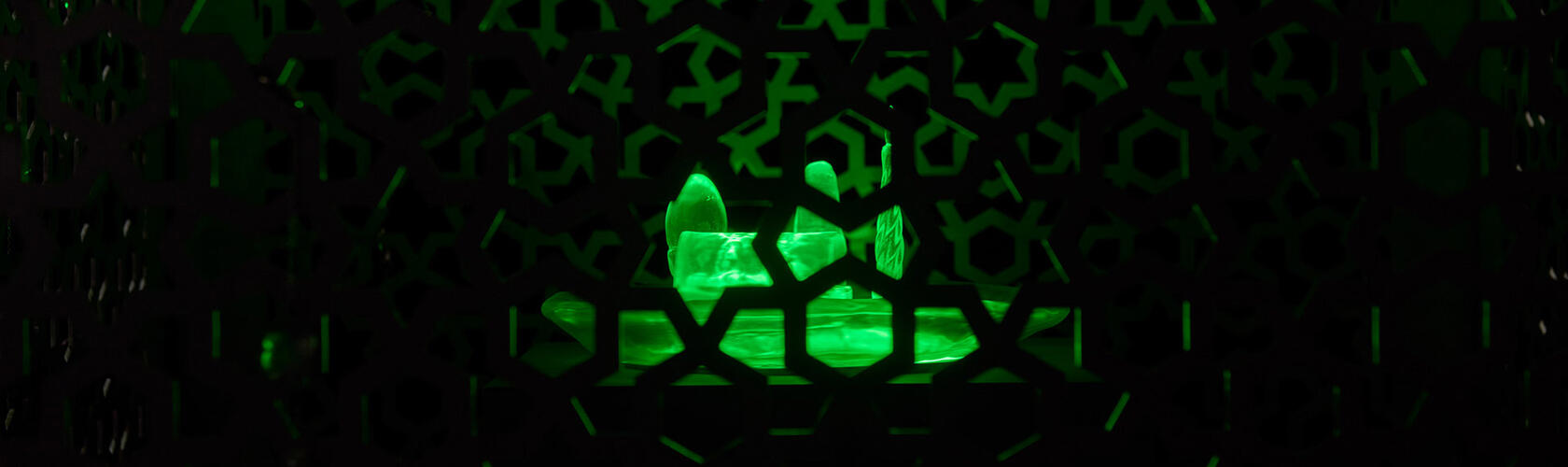
In a darkened room, voices in English and Farsi describe bathhouse encounters and sapphic yearning from a speculative Iranian past. These are the stories of four digitally rendered, holographically projected avatars, presented as black and white busts adorned with jewellery, veils and other headwear. Nearby, a steel shrine is suspended from the ceiling; a series of small portraits hangs from its panels, which feature a cut-out design of eight-pointed stars and crosses. In the centre of the room, green light radiates from within another, larger shrine, its sides again laser-cut with Islamic geometric patterns. Mystical, reverent and a bit sexy, this is the temple-cum-dark-room of Kasra Jalilipour’s ‘Gut Feelings 2.0’ at Birmingham’s Grand Union.
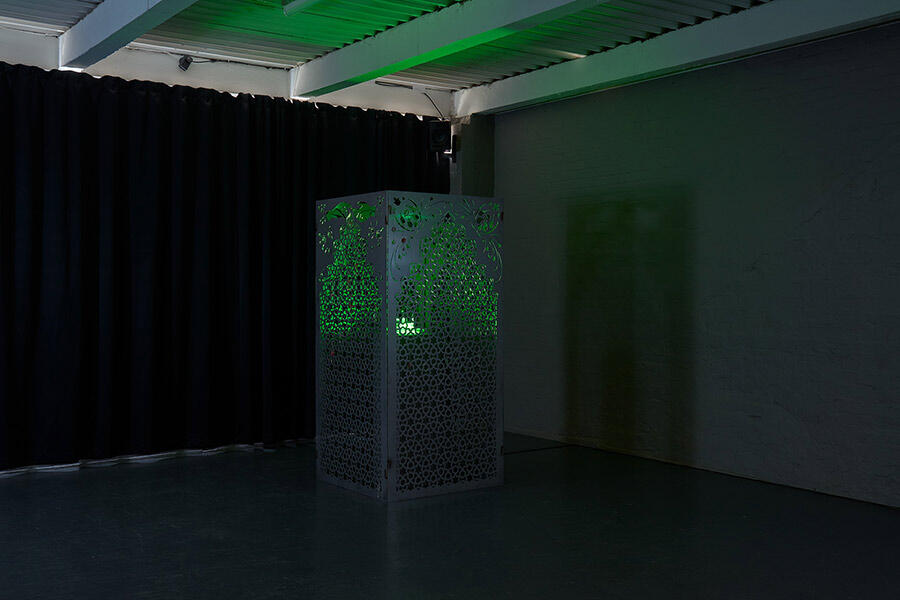
Inspired by Catholic and Shia reliquaries, Jalilipour uses this imagined sacred space to forge a devotional lineage of queer and trans lives in Qajar era Iran (1789–1925), drawing from the artist’s extensive research into the period. Viewing the archive as never neutral, and the role of the individual researcher as always limited, Jalilipour uses strategies of critical fabulation and collaboration to construct narratives from their research material. Three of the four projected figures were produced with the queer and trans diasporic Iranian artists Sorour Darabi, Sevin Shabankareh and Priscillia Kounkou-Hoveyda, their faces serving as the basis of the computer-rendered avatars. These new characters’ stories, told through looped-text audio written and read by the collaborators, tell of private homosocial spaces and encounters, such as a 19th-century gay bathhouse dalliance and flirtations between two women enslaved by members of the Persian nobility. While fiction allows Jalilipour to speculatively fill in the gaps in archival documentation of queer and trans lives from this period of Iranian history, the process of collaboration ensures that the building of this lineage is an appropriately social, non-hierarchical endeavour.
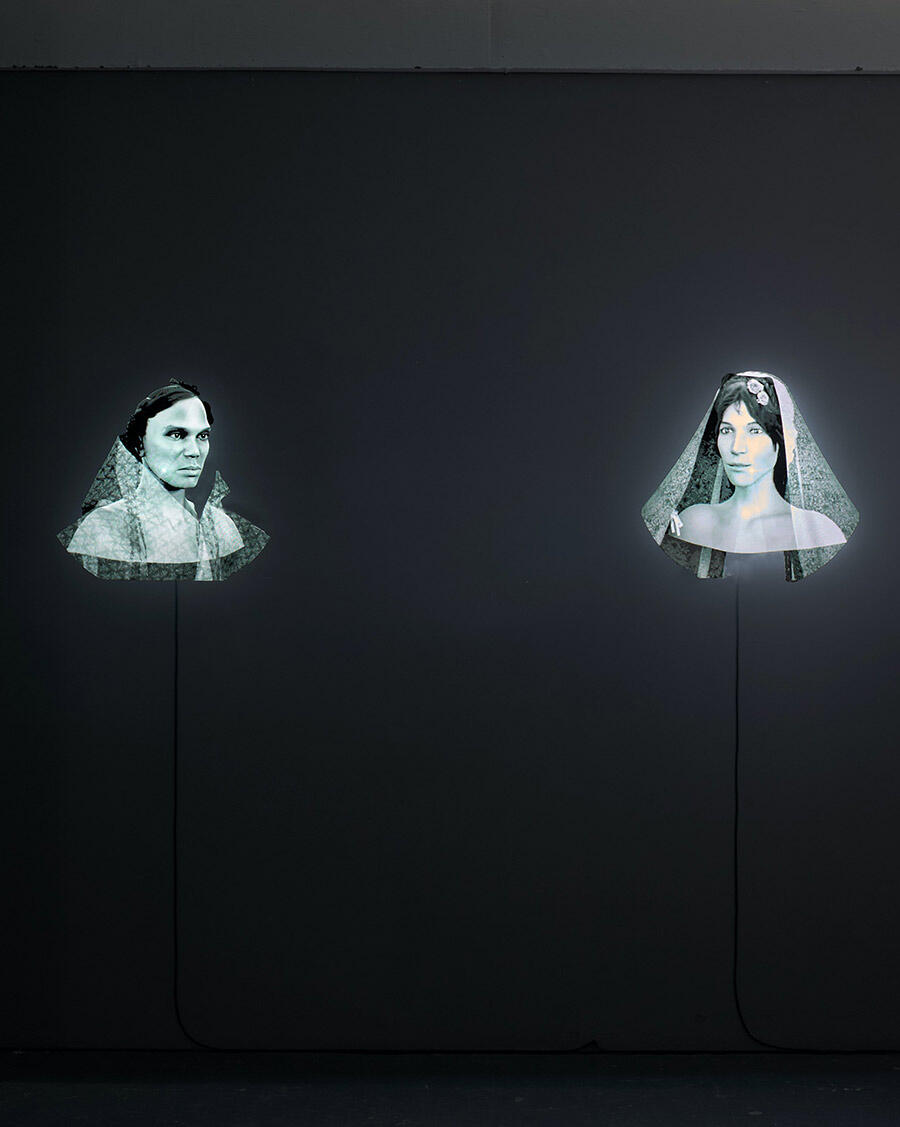
Alongside these fictional characters, Jalilipour includes Tahirih Qurrat al-Ayn, a women’s rights activist and poet who was martyred in 1852 for her advocacy for women’s emancipation. Unlike the others, whose lives are imagined on the basis of scant and unreliable archival references to private same-sex spaces, Tahirih’s public activism is better documented. Although today Tahirih would not be considered queer, she stands as a radical figure of Iranian gender liberation for Jalilipour and his contemporaries.
Jalilipour’s archival research saturates the visual elements of the installation, too. The accessories worn by the animated portraits are modelled directly on those depicted in Qajar art and photography; the metal charms that hang from the smaller shrine are etched with historical portraits of eunuchs; and illustrations of hands and flowers drawn from Qajar-era manuscripts are cut into the stainless steel walls of the shrine. By refiguring historical visual references in contemporary media and materials, Jalilipour allows different times to collide through a process of remembrance, seeking novel ways for the past to inflect the future.
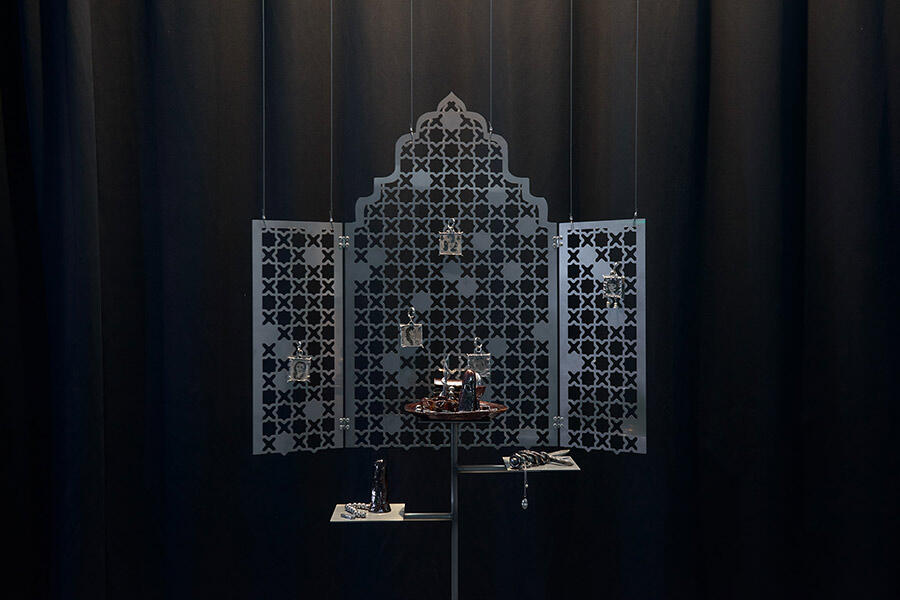
This is perhaps most evident in the exhibition’s central motif: a ritual tray holding an egg, a dildo, a jewellery box and a candle. This tray of objects, which appears in ceramic, digital and 3D-printed forms, represents the offering made between two women during the ‘vows of sisterhood’, a pre-Islamic ritual of same-sex union that was practiced in sex-segregated religious spaces until the late 19th century. Placed within the exhibition’s two shrines, these trays stand for the possibilities of queer desire and embodiment in Iran before westernization under the Pahlavi period (1925–79). As bathhouses, harems and places of worship prove to be a continual source of inspiration for Jalilipour, the artist poses a provocative question: can single-sex spaces be liberating for queer and trans people when reimagined outside the fraught confines of the western culture wars?
Kasra Jalilipour’s ‘Gut Feelings 2.0’ is on view at Grand Union, Birmingham, until 16 August
Main image: Kasra Jalilipour, ‘Gut Feelings 2.0’, 2025, exhibition view. Courtesy: the artist and Grand Union, Birmingham; photograph: Patrick Dandy