-ethna-rose-o%27regan-thumb.jpg?VersionId=kL7ucmByjlyVoHLq_.RmW8zdpMTLRs2Y&itok=pX-0wvWR)




Oswald Oberhuber and the Art of Flux
At Galerie Krinziger, Vienna, the artist’s works act as a record of thought in motion
At Galerie Krinziger, Vienna, the artist’s works act as a record of thought in motion
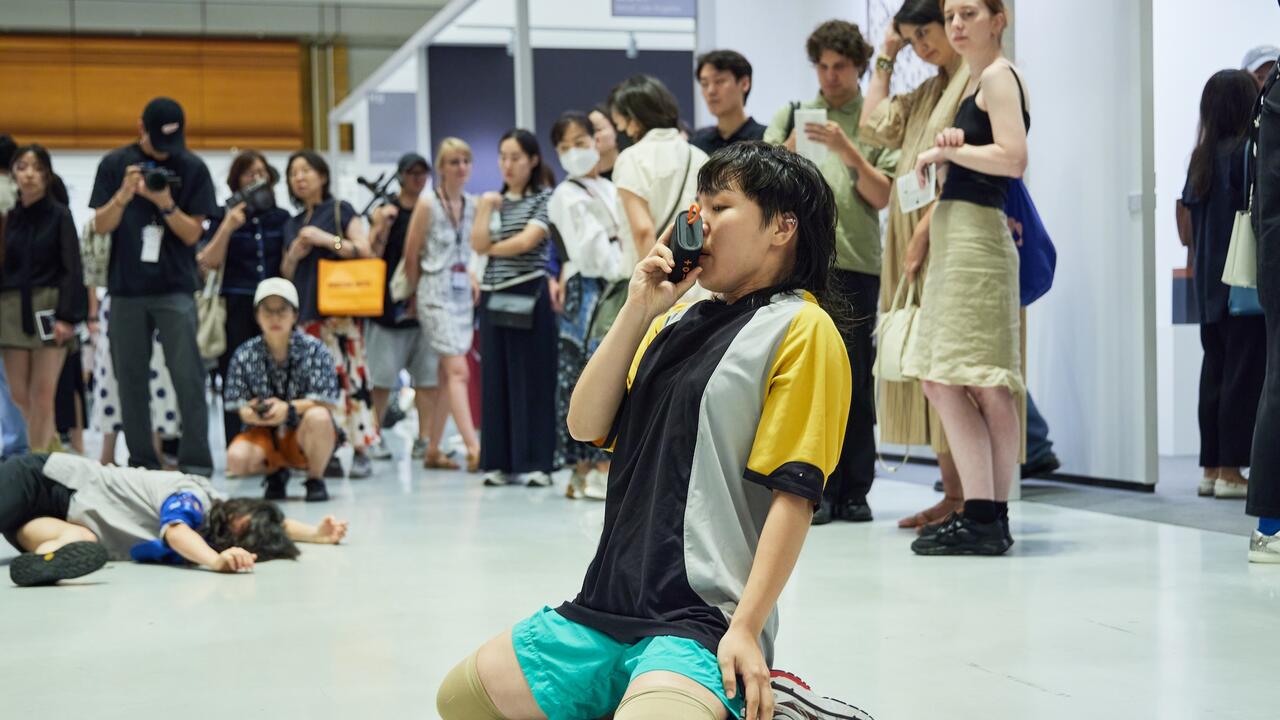
After more than three decades, the practice of Oswald Oberhuber returns to Galerie Krinzinger as a solo exhibition, bringing together works from various periods and, as the title suggests, across different media: ‘skulptur – malerei – zeichnung’ (sculpture – painting – drawing). It occupies the second, smaller space of the Viennese gallery, spanning two rooms and a narrow corridor, offering a concise insight into the artist’s vast and dynamic oeuvre. Informed by the spirit of European post-war art informel, which embraced spontaneity, gestural techniques and an emphasis on materiality and process, Oberhuber was guided by the principle of ‘permanent change’, first introduced in his text Die permanente Veränderung in der Kunst (Principle of Permanent Change in Art, 1956). Accordingly, the artist rejected any notion of evolution or continuation in his work, opposed stylistic consistency and resisted the development of a recognizable signature style.
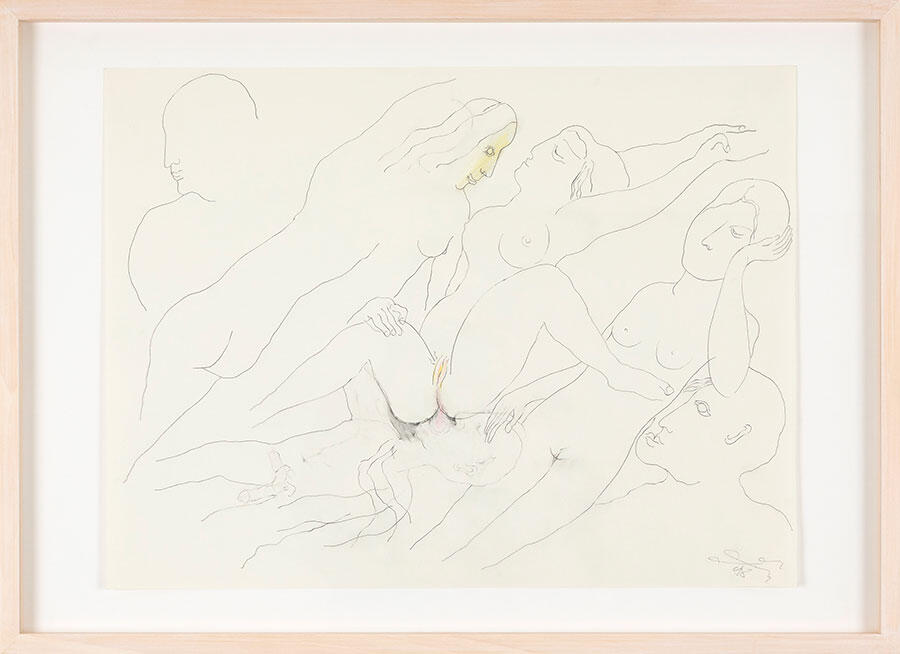
And yet this credo forms a through line: Oberhuber’s striving for plurality and spontaneity lent his practice a consistently impulsive and restless character. This is attested to in the exhibition, where sculptural objects assembled from cardboard or wooden boxes sit in direct opposition to lightly coloured crayon and pencil drawings from the 1990s that depict silhouettes of lustful naked human bodies. Several are distinctly erotic, such as Untitled (1998), where intertwined nude figures, drawn with a flowing pencil line, are accented by minimal yet strategic touches of colour: yellow on a face, soft red around the genitals.
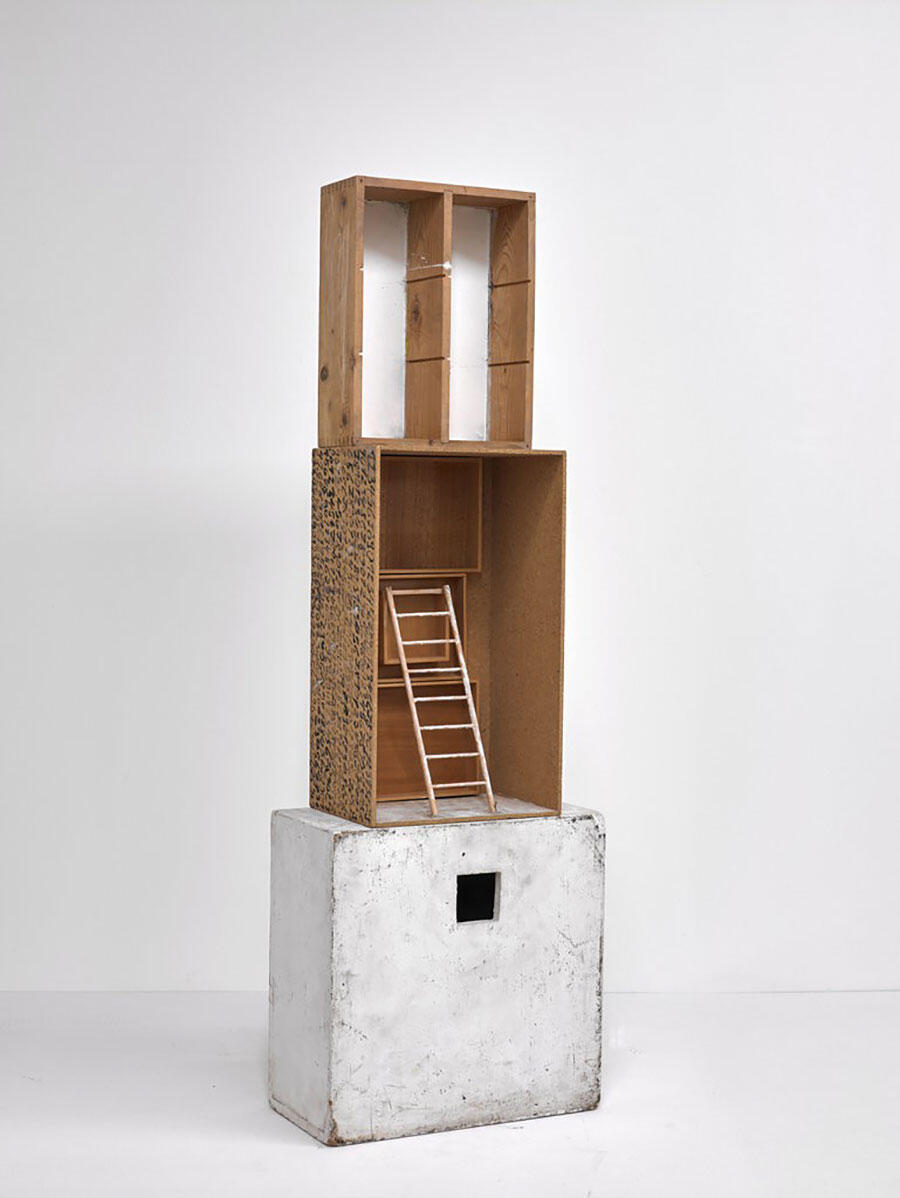
Two of the most intriguing works in the show are slender, vertical sculptural assemblages, each just under 2 metres tall, merging various found objects and creating textural contrasts. Untitled (1967) stands on a low, whitewashed wooden platform and consists of an open wooden box filled with tangled wire mesh, from which small tags hang like archival markers, while slim wooden planks extend dynamically from its top. Nearby, Hundeleiter (Dog Ladder, 1975) comprises three stacked wooden boxes of varying sizes, two open, one closed; inside the middle box are four small cubicles and a delicate wooden ladder leaning against the back wall, leading nowhere. Both constructions are stable yet precarious, as if evoking the impermanence of artistic or sociopolitical systems, including the fragile architectures of post-war governance. In this sense, Oberhuber’s ‘permanent change’ can be read as a desire for constant self-determination – a value of particular significance to someone whose formative years were overshadowed by the totalitarianism of Nazi ideology.
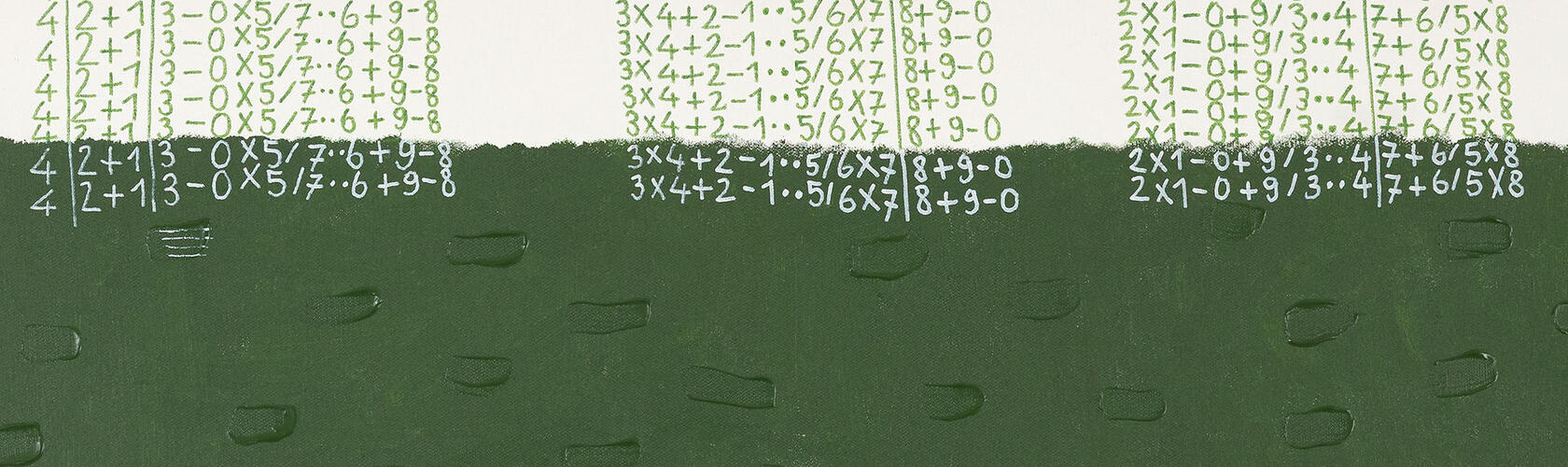
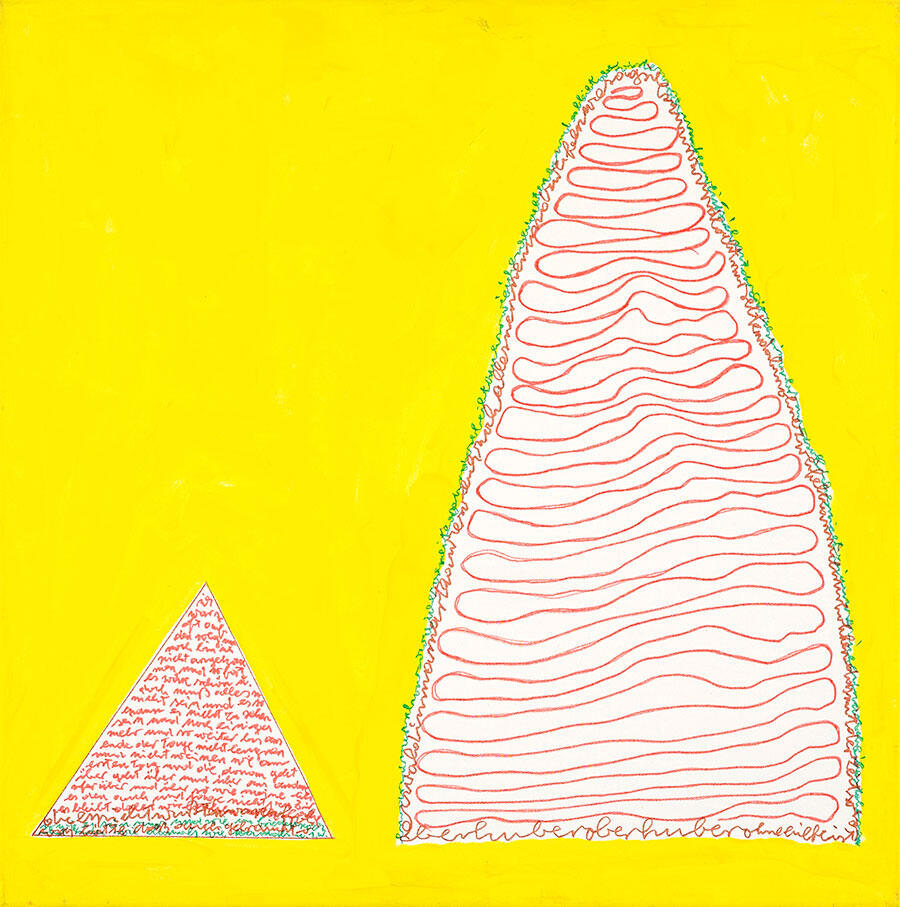
Despite his commitment to unpredictability, Oberhuber’s interest in numbers and letters remained consistent throughout his work from the 1950s onwards. The side surfaces of the middle box in Hundeleiter, for example, are densely inscribed with handwritten numbers. Various equations also appear in his late abstract acrylic paintings, such as ‘Begrenzt’ Zeitlos (‘Limited’ Timeless, 2009) or Wo ist die Berechnung (Where is the Calculation, 2010), resulting in strictly formal compositions stripped of computational meaning. Similarly, the artist’s name and signature frequently became vital elements in his works, as seen in the painting Weicher Turm (Soft Tower, undated), where the repetition of his surname extends into illegible sentences and forms rhythmic waves, filling out one of the two triangular forms set against a stark yellow background. This work explores the relationship between the visual and the verbal, aesthetics and semantics, and delves – through the artist’s own handwriting – into the tension between artistic attribution and clear identification.
Yet it is drawing, both figurative and abstract, that underpins every phase of Oberhuber’s practice, as it embodies immediate notation combined with conscious reflection. Rather than aiming for completed compositions, Oberhuber’s drawings are often fragmented and exploratory, reflecting the process-oriented mindset that permeates his body of work: ‘sculpture – painting – drawing’ as a record of thought in motion, never fixed or final.
Oswald Oberhuber’s ‘skulptur – malerei – zeichnung’ is on view at Galerie Krinziger, Vienna, until 23 August
Main image: Oswald Oberhuber, Wo ist die Berechnung (Where is the Calculation, 2010, acrylic on canvas, 80 × 100 cm. Courtesy: Galerie Krinzinger and Estate Oswald Oberhuber; photograph: Tamara Rametsteiner