-ethna-rose-o%27regan-thumbb507.jpg?VersionId=kL7ucmByjlyVoHLq_.RmW8zdpMTLRs2Y&itok=pX-0wvWR)



Work in Progress: Eugene Jung
The Seoul-born sculptor on her Harlem studio, anime and ‘invisible disasters’
The Seoul-born sculptor on her Harlem studio, anime and ‘invisible disasters’
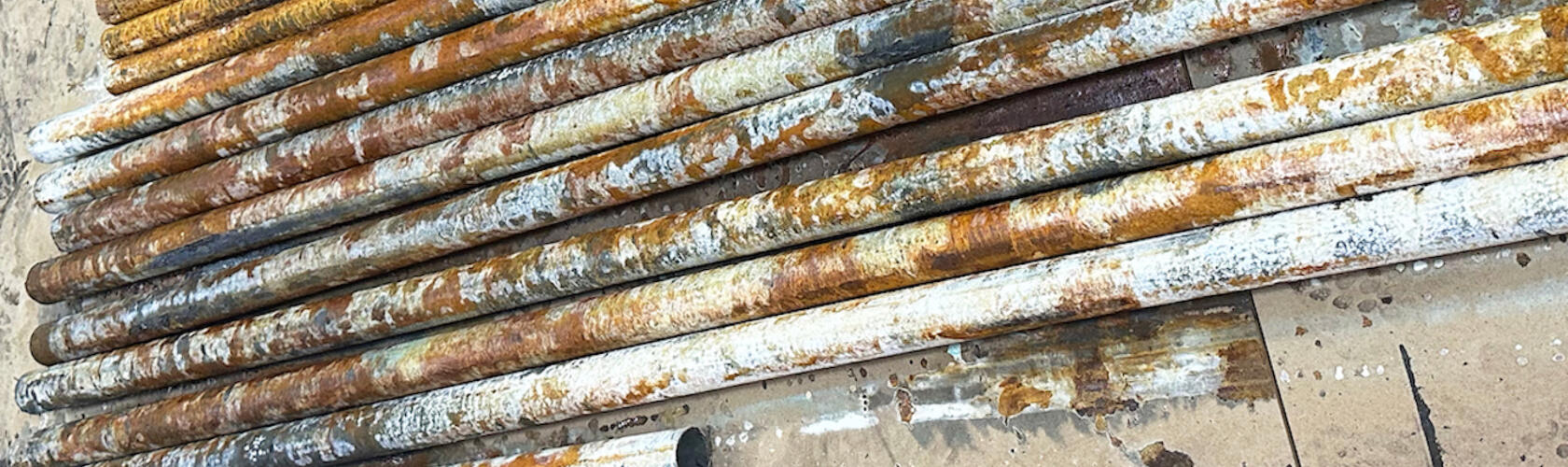
Less than a year ago, artist Eugene Jung moved from Seoul to New York, seeking a new challenge. The grittiness and spontaneity of the city allowed Jung the ‘room to improvize’. She collects rusting scrap metal from the streets, converting the movements and traces of the city into physical forms that have ‘weight in the real world’.
The artist has been following urban and natural disasters and witnessed several herself in her lifetime. Closing the ‘gap’ between image and reality has become her life-long assignment.
As Jung prepares to show new sculptures with sangheeut at Frieze Seoul 2025, she reflects on her intercontinental move, the influence of Japanese anime on her work, and the abstract wreckage of unseen catastrophes.
Monica Jae Yeon Moon Where is your studio?
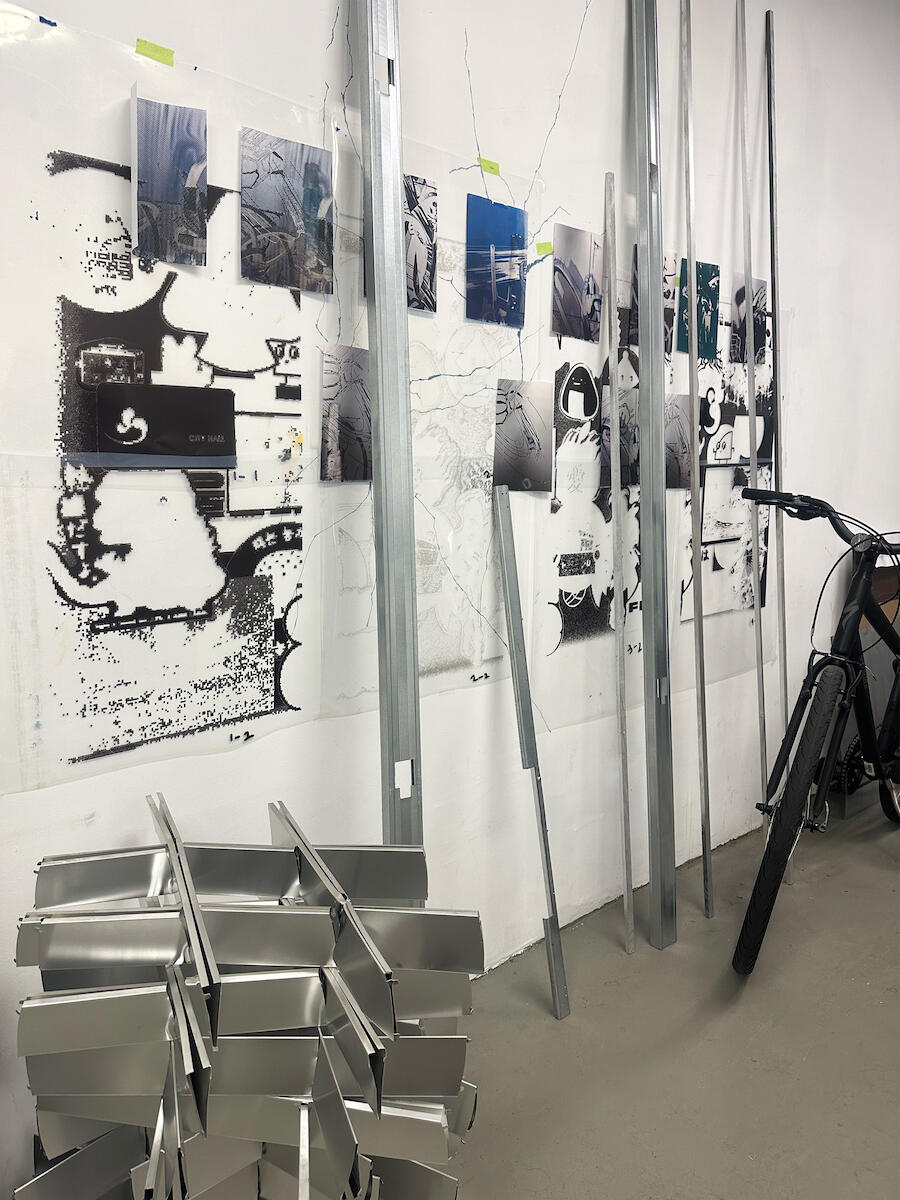
Eugene Jung I moved to New York from Seoul last September, and I’m currently working out of a studio in Harlem, Manhattan. I never imagined that I would have a studio in Harlem, so I didn’t have any prior information or expectations, but I think a lot of the music and graffiti I’ve encountered on the street has become a point of connection with my work.
MM Why did you move to New York?
EJ I came to New York for graduate school. I’ve lived in Seoul since I was a child and I think the biggest reason to move was that I wanted to change my environment. Seoul has many advantages because it has a lot of infrastructure and feels so comfortable and familiar, but I needed a challenge in my work, and I wanted to face New York directly, as a city at the centre of capital and disaster.
MM What is it like working in New York compared to Seoul?
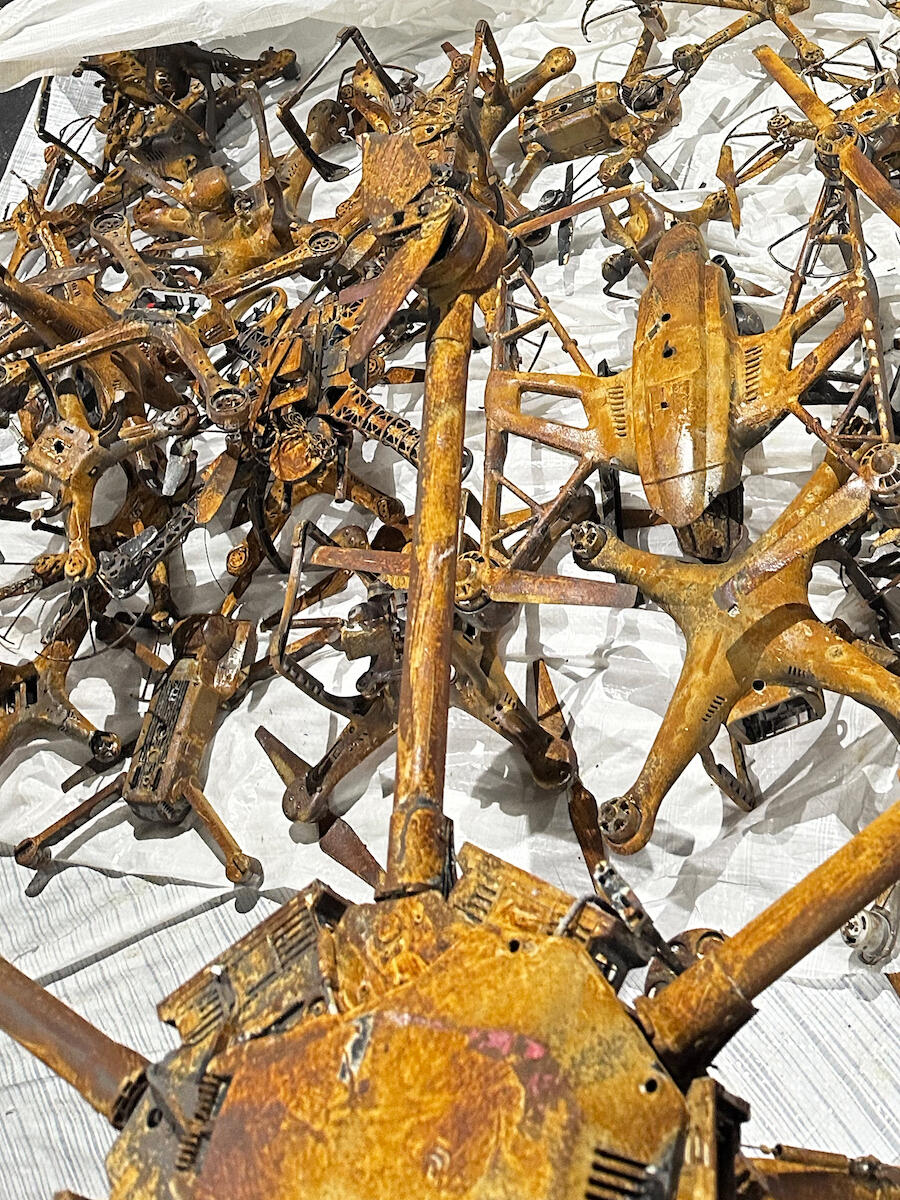
EJ Seoul is very clean and tidy. This means it was difficult to get things like scrap materials for my work. I had to contact a lot of drone companies to get the broken drones that I use in my project for Frieze Seoul. There was a very detailed process of thinking about what I’d need before I could start working.
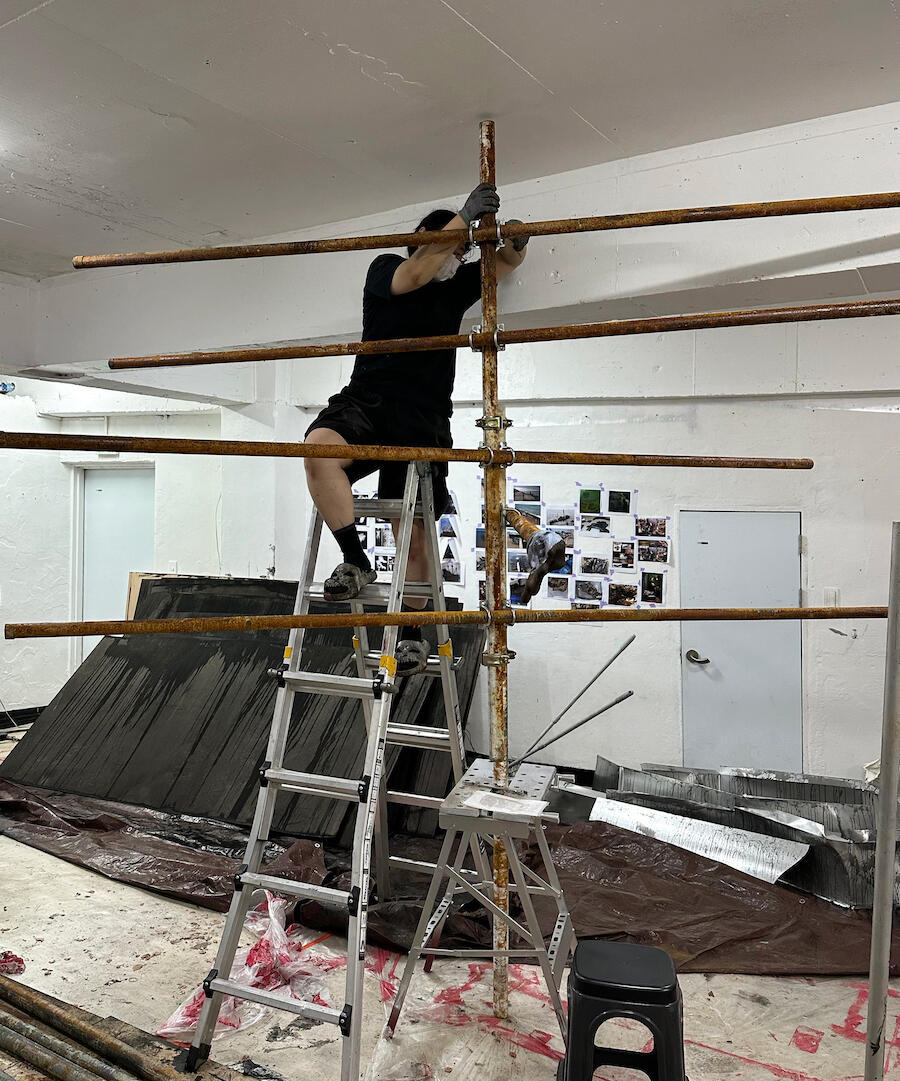
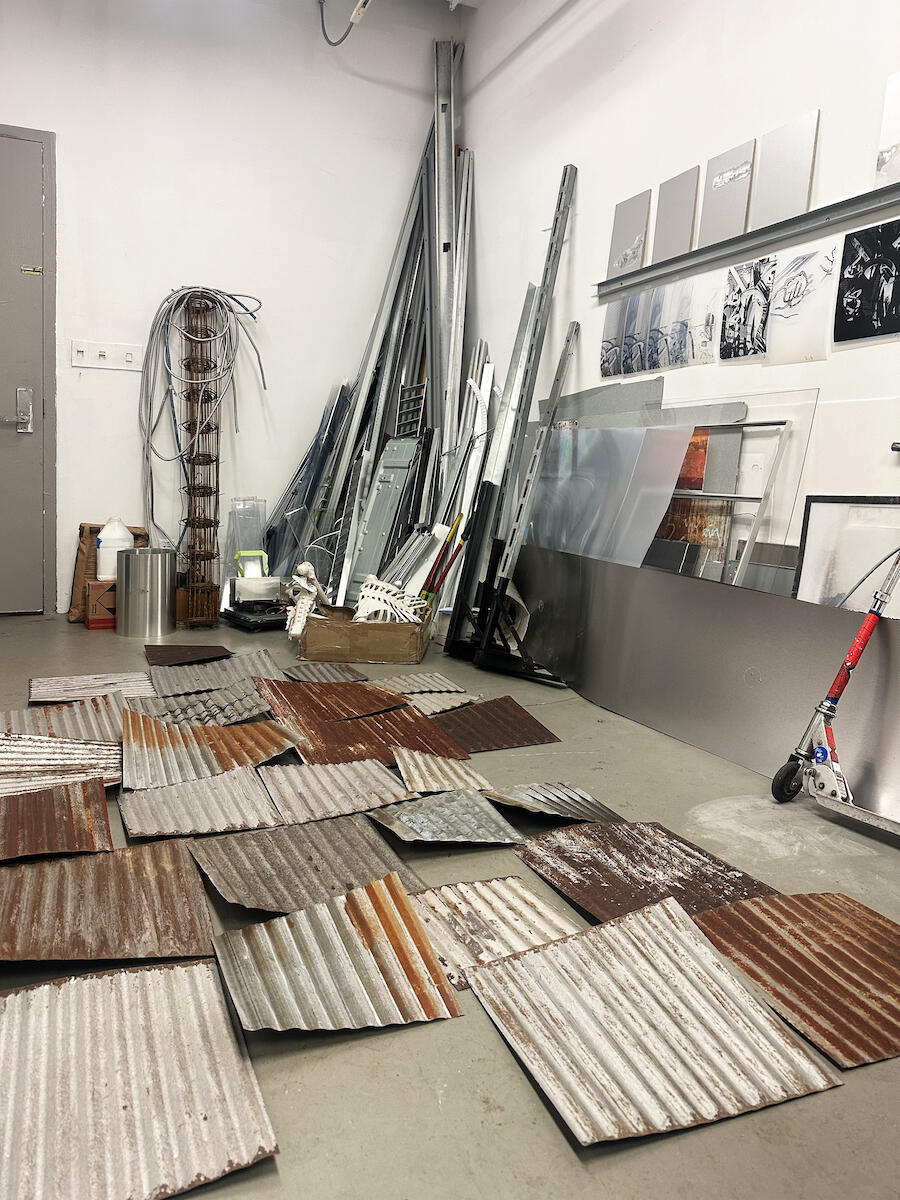
In New York, there’s more room to improvise because there’s so much stuff lying around the city. I’ll be walking down the street and I’ll pick up a piece of junk and take it back to my studio. My friends spot things and share their locations with me, which is fun. My studio is right next to a construction site, so when they’re throwing out all the waste materials, I’ll load a wheelbarrow.
MM Tell us about your work for Frieze Seoul.
EJ I’ve been dealing with images of disasters and catastrophes in my work, but I wanted to go a little further and think about invisible disasters. I think that the constant construction, the overflow of garbage in the city and the many homeless people on the streets are all traces of the gaps in the system or the collapse of infrastructure. I capture the traces and movements of the urban system and make them visible and physical.
MM You work with rusted steel sheets, poles and drones. Can you talk about your material choices?
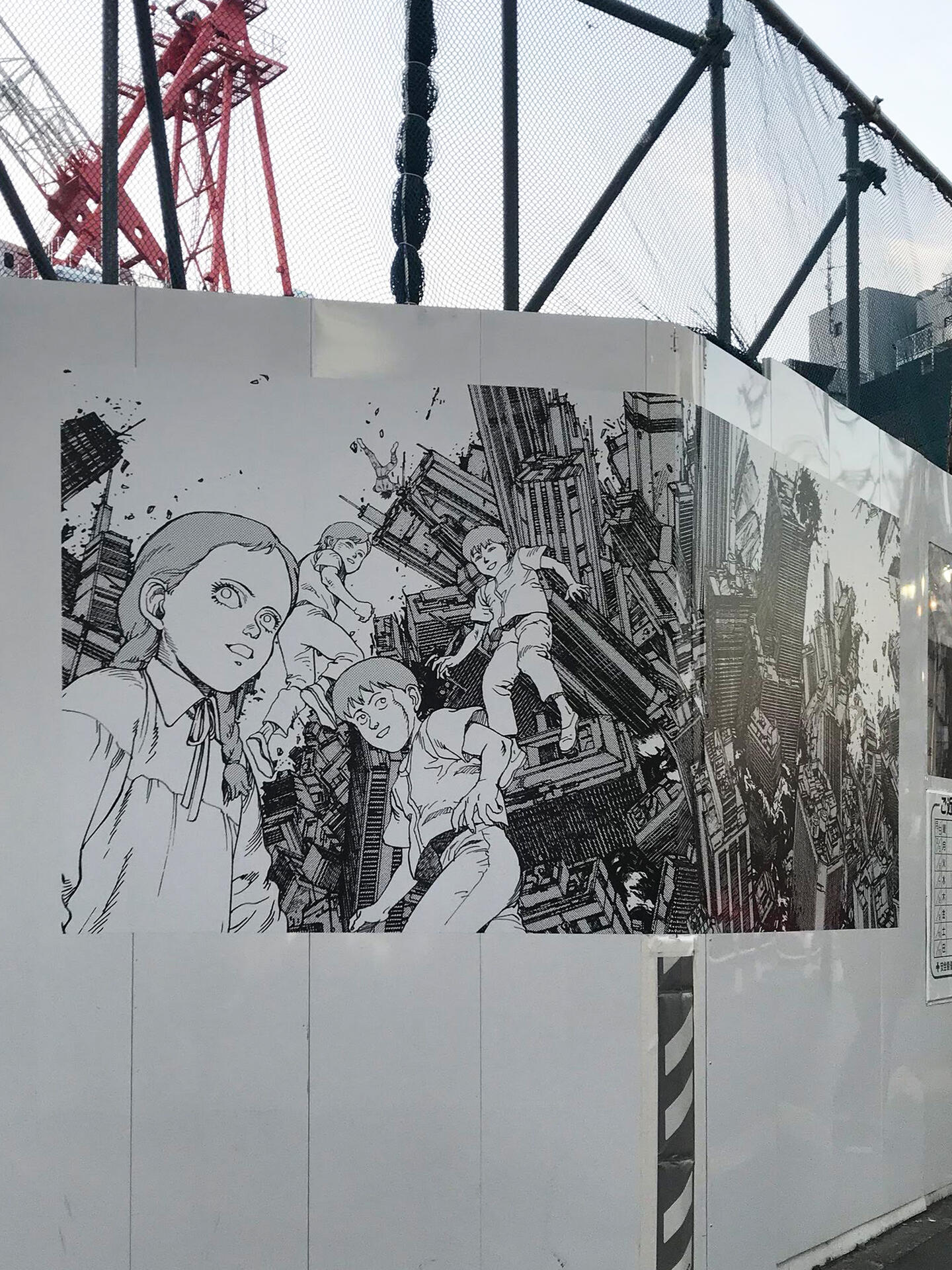
EJ In both Seoul and New York, I’ve always collected and used architectural materials. I am deeply influenced by the images of collapsed cities and crumbling buildings from the animations and comics that I saw at a young age. I feel like those images are embedded in my cells – I use building materials to materialize them. The fact that my work has weight in the real world is important to me.
I don’t use drones to directly refer to a surveillance society; I use them to visualize the movements and flow of systems in the city. For example, in New York, the buildings are constantly rising into the sky, heavy machinery digs up the ground, while drones and helicopters carrying wealthy people fly around. I thought a lot about how to convert these movements into sculptures – what kind of structure and materials would be needed. The result of this contemplation is the work I am presenting at Frieze Seoul.
MM How do comics, animation, video and sculpture come together in your work?
EJ In the late 20th century, the South Korean government had restrictions on importing and distributing Japanese culture, but in the early 2000s, shortly after I was born, those restrictions were completely lifted. I grew up surrounded by Japanese culture.
I read a lot of manga series, like ‘Evangelion’, ‘Akira’, ‘20th Century Boys’ and ‘Monster’, which all stem from the end-of-the-century aesthetic. Although I could see there was the gap between real disasters and the disaster images I saw in manga, I also realized that I worked trapped in those images.
When the Great East Japan Earthquake and Fukushima nuclear accident hit in 2011, I was shocked at myself for feeling a sense of amazement, seeing countless images of buildings collapsing, everything being swept away on social media and thinking to myself: This is just like a movie. At the time, my older brother was studying abroad in Japan, and people kept asking me, ‘Is your brother okay? Is he safe?’ But every time I received those messages, it didn’t feel very real to me. As his younger sister, I should have been worried about him, but I felt like my senses had become numb.
MM What do you mean by ‘invisible disasters’?
EJ In the past, I was interested in spectacles of landslides, earthquakes and explosions, but after the Covid-19 pandemic, I realized that disaster is right on my doorstep. Now, living as an outsider in New York City, I see that real dangers constantly lurk around us. A disaster can refer to the collapse of the surrounding environment, but it can also be defined by how much one feels a sense of crisis. We face many great dangers, including the climate crisis, but these dangers won’t collapse all at once. The inability to sense danger can lead to an even greater disaster.
MM What does time in the studio mean to you?
EJ I spend a lot of time outside, meeting people, walking and cycling. In the studio, I think about how to internalize the materials I bring in from the city and how I can relate to them. Experimenting with these materials – trying to stick them together, cutting them, attaching and separating them from one another – is the most enjoyable part for me. In a way, the studio feels like my brain.
MM What kind of work would you like to do in the future?
EJ Lately, I’ve been thinking more about abstraction. I want to expand on the meaning of disaster and think about how I can turn the sensations that I am aware of, or perhaps not even aware of, into more abstract works. Honestly, I think this is something all artists think about.
I think the power of my work is the impact of its physical presence in a space. The question of how visual art can evoke new sensations in people is, in a way, an unsolvable puzzle that I may have to carry with me until I die.
Further Information
Frieze Seoul, COEX, 3 – 6 September 2025.
Discounted tickets are now sold out, limited full-price tickets available. Become a Frieze Member for premier access, multi-day entry, exclusive guided tours, and more.
For all the latest news from Frieze, sign up to the newsletter at frieze.com, and follow @friezeofficial on Instagram and Frieze Official on Facebook.
Frieze Seoul is supported by Headline Partner LG OLED, in a collaboration that merges the worlds of art and technology, and Global Lead Partner Deutsche Bank, continuing over two decades of shared commitment to artistic excellence.
Main Image: Eugene Jung’s studio. Courtesy: the artist
d4e3.jpg?VersionId=wFDp5K3WVfb.Dv.tr0eUQ2kmYPfRI5_s&itok=XPHdkN8B)